
Which Glue is the Best to Use for Guitar Building?
Going back several hundred years to when the instrument we now know as the guitar was first produced in Spain, our luthier forefathers were bonding wood together with animal-based glues. These glues are made from rabbit skin, fish bones, horse hooves, and anything that contained collagen.
Today we mainly use synthetic aliphatic glues. These are thankfully not as odorous as animal-based glues. They also form stronger bonds and are easier to work with.
The best wood glue to use for almost all aspects of guitar building is Franklin Titebond aliphatic glue. When set, it is often stronger than the wood itself.
To find out more about why we recommend aliphatic glues rather than other glues available to modern guitar builders, keep on reading below.
The Glues
Several types of wood glue are used in modern guitar building. The most commonly used glues fall into four main categories:
- Aliphatic glues
- Hide glue
- Cyanocrylate
- Epoxy Resin
At GuitarAssembly, we have successfully and unsuccessfully tried every conceivable type of adhesive over hundreds of tests and repairs we have carried out over the last decade. Plus, we have built hundreds of instruments in our workshop for ourselves and our students.
As a result, we have learned (the hard way) which glues to use for which purpose.
Aliphatic glue

Guitar builders most commonly use aliphatic glue today. Unlike animal-based hide glue, it is ready to go straight out of the bottle.
We use it for all wood-to-wood bonding and repairs at GuitarAssembly. Jobs that fall under this umbrella include fixing bridges and fretboards, jointing body blanks, and closing most cracks.
Aliphatic glue has a much thicker consistency than PVA and has a light yellow color. When its sets after 24 hours, the color ranges from translucent to a light amber color, depending on the brand.
It has the advantage of being water-soluble, and before it cures, it can be cleaned with water.
When fully set, it is often stronger than the wood itself. Hard enough even to sand.
Aliphatic glue sets between 10°C (50°F) and 43°C (110°F), but be careful not to use it below 12°C (53°C). It is not suitable for use in outdoor settings due to temperature and moisture fluctuations.
One drawback to how hard it sets is that it does not absorb wood stains.
Stains will sit on top of the glue and do not penetrate through to the wood. But as it is sandable, this is not a problem.
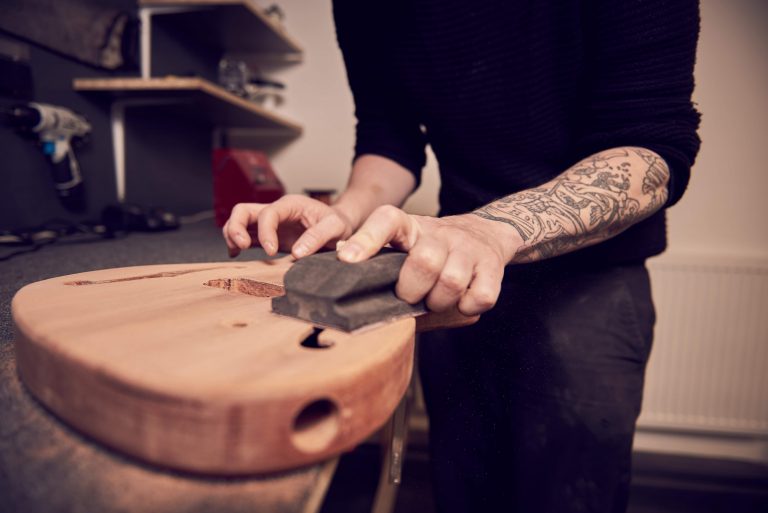
Any excess glue can be sanded away on the surface 24 hours after application. Stains can then be applied to the wood as usual.
Popular brands include Titebond & Lepage. As mentioned above, we use Titebond in the workshop.
Hide glue

Our ancestors used animal glue for many purposes, including tool and furniture making, and eventually luthiery.
The famous 18th Century master luthier Antonio Stradivari likely used a casein glue of animal origin that was likely made from milk solids. It bonds firmly, sets hard, and is waterproof.
It is long-lasting, as over half of the Stradivarius instruments produced have survived for more than 300 years. It is still used today in quality plywood and laminates.
But for many centuries of human history, hide glue has been the predominant animal glue used. It is produced from the rendered collagen found naturally in bones, skin, and connective tissues of animals.
Hide glue is supplied as granules, pearls, or flakes, comes in a variety of strengths, and one of the main positives is that it can be stored for a long time. In its dry form, it will last thousands of years.
Hide glue is prepared by dissolving the granules in water and then heating them to the required temperature in a glue pot. It has a limited pot life of about a week as it cultures bacteria. Once in liquid form, the glue can be cooled to a gel and then stored by freezing.
The need to heat the glue is one of the drawbacks for us at GuitarAssembly. It is hard to justify the expense of a professional-grade heating pot when we might only use it once or twice a year. Plus the glue’s preparation time of an hour or over is less than convenient.
However, Martin trained under the late Paul Egholm at Barleylands, who built some wonderful lutes. He only used hide glue on his instruments, so it does have its uses and applications.
Hide glue has the consistency of gelatin and should always be applied warm. When it is at the right temperature, the time you have to apply the glue is only about one minute. After this, the glue becomes less workable, but it can be returned to the pot to be reheated and reactivated. It cures in around 24 hours and sets as it cools.
We use hide glue very rarely at GuitarAssembly. Typically only when working on a vintage instrument and we suspect hide glue was originally used. We see very few instruments of this type.
Titebond has a liquid hide glue which speeds the preparation process up, but it is unsuitable for long storage once opened.

Luthier’s Mercantile also sells fish glue that can substitute for hide glue.
Both of these glues resist temperatures over 70°F (21°C) which is about the temperature inside the trunk of a car in summer.
Cyanoacrylate

Cyanoacrylate is probably better known as Superglue dries instantly and is creates extremely strong bonds on almost any material. Anyone that has ever got some on their fingers will tell you that.
The only areas of guitar building we would use superglue for are on really small components. It penetrates well and thinner viscosities can sip into tiny cracks and connections.
You are not going to use it to join body blanks or seams or anything like that. You might use it for fretboard inlays, for example.
It dries clear and hard can be sanded just as well as aliphatic glue.
There are a variety of brands, but this is the glue where it matters least as you will use it so little. Well-known brands include Loctite, Krazy Glue, Gorilla Glue, and Elmers.
We have this one in the workshop, which is an industrial-grade superglue that does what it says on the label. Each of these can be purchased on Amazon.
Here is the Superglue GP which is good for plastics and metals, and here is the Superglue HV which is the one you want for wood.

The major downside to any cyanoacrylate is that it is extremely toxic. When using it for an extended time you must keep your working area well-ventilated due to the fumes.
Epoxy Resin

Most of the downsides of superglue, apply to epoxy resin too.
Epoxy resin is a permanent adhesive that must be removed by sanding once it sets. So permanent in fact that it is the glue of choice for boat builders.
Like superglue, it is not for use on joints but rather can be used as a laminate, or to fill in dents and chips on fretboards for example. So we mainly use it for its ability to fill small cracks and dents, which we can then sand down later on.
We use epoxy resin in combination with a hardener. The ratio of resin to hardener is dependent on the brand.
The downsides are that epoxy has a short working time as it sets quickly. If you get the ratio of resin to hardener wrong, you could be working with an adhesive that dries too quickly or one that does not cure at all.
Temp Table
Its most likely useful to include a table with useful stats on the different glue types mentioned above. Here it is:
| Titebond Wood Glue | Dry (Hot) Hide Glue | Liquid Hide Glue | Super Glue | West System Epoxy Resin | |
|---|---|---|---|---|---|
| WORKING TEMP (°F) | 50° + | 140° – 212° | 70° – 90° | 50° + | As low as 35° + depending on formula |
| WORKING TEMP (°C) | 10° + | 60° – 100° | 21° – 33° | 10° + | As low as 2° + depending on formula |
| OPEN TIME | 5 minutes | 1 minute | 10 minutes | 15 secs | 5 minutes to 90 minutes depending on the formula |
| CURE/ CLAMP TIME | 24 hours | 24 hours | 24 hours | None | Around 72 hours depending on temperature and open time |
| DRY COLOR | Amber – Yellow | Amber | Amber | Clear | Clear |
| CLEANUP | Water | Water | Water | Acetone | Acetone |
| WATER RESISTANCE | Low | Low | Low | Excellent | Waterproof |
| SHELF LIFE | 2 years | Infinite | 1 year | 12-15 months | 3 years for resins and 2 years for hardeners |
Summary
So in short, the very best wood glue to use for almost all aspects of guitar building is American Franklin Titebond glue. It is the only one we recommend for nearly all applications.
The other glue types we have mentioned all have their uses but we typically only use them in very niche circumstances. So in the main, they stay on the shelf. For general use, there are too many drawbacks when compared with the Titebond aliphatic glue.