
What are the differences between neck and bridge pickups?
Guitar pickups come in a wide variety of types and sizes that determine how we are heard.
The diversity of pickups means that there is an option to suit any guitarist playing in any style.
If you play the blues, then there is a fair chance that your pickups are not going to be high-gain enough to play death metal as well.
Amps and pedals can cover a lot of the ground for you. But you will find it difficult to hone in on the exact tone you are searching for.
Pickup Positions
Most electric guitars have several pickups that provide players a range of tone.
Acoustics and some electric guitars do have just one pickup. Leslie West of Mountain famously wrestled a wide variety of tone from his single humbucker Les Paul Jr.
Usually, most electric guitars will have two or three pickups.
Each pickup will either be in:
- the bridge position
- the middle position
- the neck position
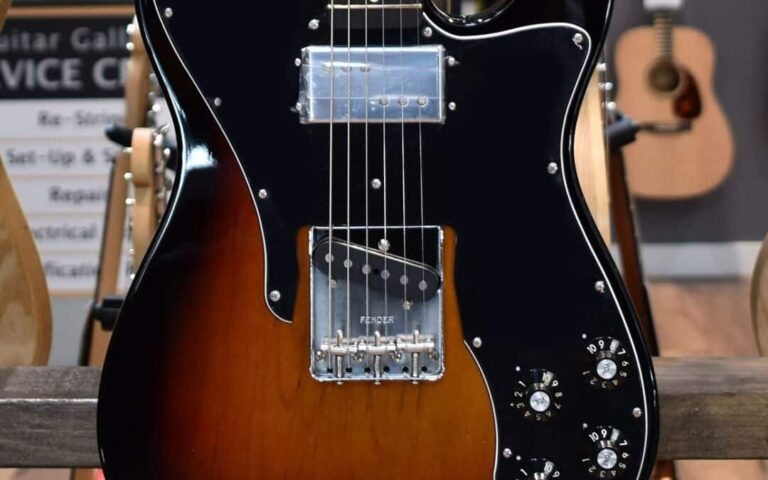
You will find a difference in the sound between these pickup positions, namely a brighter sound the further you move away from the neck towards the bridge.
So the bridge pickup will give you a little more treble should you want to cut through a wall of sound. Perfect for riffs and solos.
Conversely, the neck pickup will give you a rounder, warmer sound suitable for chords and chunky rhythm parts.
The kind of pickup we are using here provides even more variation. Your guitar may have humbuckers, single coils, or both.
By the end of this article, we will clear up the differences between the various pickup combinations.
Hold on, what is a pickup exactly?
Think of a pickup as the microphone a guitar sings into. Where a singer’s vocal cords vibrate, creating a sound the microphone picks up and sends to an amplifier, the guitar’s strings vibrate and this is received by the pickup.
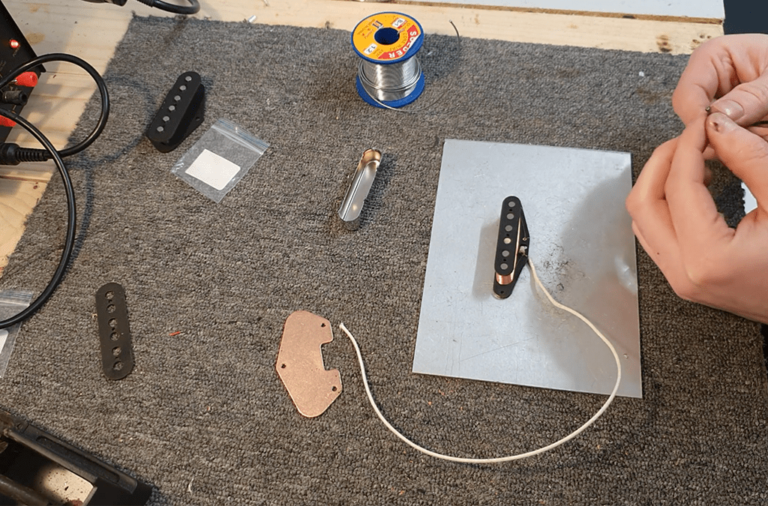
The pickup itself is a wire wrapped magnet that takes that vibration of the strings and creates an electronic signal. This signal is sent to an amplifier which makes it audible.
Pickup sound at the bridge
Aside from physical location, the difference between pickup positions is the tone. As mentioned earlier, the tone at the bridge is brighter.
Bridge pickups create the electronic signal from string vibration much closer to the bridge. Here the string has higher tension, meaning it travels less distance. This is what gives that tighter, sharper tone.
The difference between the bridge pickup and the middle and neck pickups is defined and can be identified easily by most ears.
With distortion and overdrive, this distinction is more pronounced.
A humbucker at the bridge is a perfect choice for heavy riffs and solos when you need that extra bit of clarity to cut through the mix.
Pickup sound at the neck
The neck pickup receives the signal much closer to where strings vibrate with greater amplitude and tension is lower on the guitar.
The tone from the neck pickup is rounder and warmer and is perfect for rhythm in most cases, allowing brighter lead lines to sit on top.
You can also use the neck pickup for lead lines (there are no rules). If you are the only guitarist in a band, this is often a better choice, as you can fill out some of the lower frequencies. Expect a sweeter tone when playing lead lines.
An example of a lead line played with the neck pickup is Sweet Child O’ Mine by Guns N’ Roses. The famous intro and half of the solo are played with the pickup in the neck position.
Slash switches to the bridge pickup in the second half of the solo when he switches on the wah-wah pedal.
3-Way and a 5-Way Selector Switches
Selector switches allow us to choose between the pickups and even combinations of pickups.
Selector switches come in variations of 3-way and 5-way.
Guitars carrying two humbuckers have 3-way selector switches that enable the guitarist to select the bridge pickup, the neck pickup, and both pickups together.
Selecting both humbuckers gives you a thick tone that covers low and high-end frequencies.
3-way selectors are typically found on standard Gibson guitars (Gibson Jrs have one pickup) like Les Pauls, SGs, & ES-335s, which are fitted with humbuckers and/or p90s.
Standard Fender Telecasters (like mine) are also fitted with 3-way selectors though these usually hold single coils by default.
5-way switches are common on standard Fender Stratocasters that have three pickups.
The five different pickup positions or combinations of positions that these selectors can choose are:
- bridge
- bridge + middle
- middle
- middle + neck
- neck
The two additional positions give Strats give that well-known twang you would have heard on many blues and country records.
5-way selectors can also be found on guitars with just two humbuckers. Humbuckers use two coils to “buck the hum” (or cancel out electronic interference).
As humbuckers have two coils, they can be “split”. We can use the 5-way selector to use various combinations of these coils within humbuckers.
Summary
So that is neck and bridge pickups in a nutshell. Both have their purposes, and entire genres of music are built upon the tones we can access at each pickup position.
The bridge pickup position gives us brighter, sharper tones that we would use when soloing, riffing, or playing lead lines that need to sit on top of everything else.
The neck pickup gives us warmer, rounder tones perfect for rhythm parts, chunky chords, or single guitarists that need to fill broader frequencies.
But there are no rules, and you may find you use pickups in these positions for purposes that are the opposite to what is described here. That is how music evolves, right?
In the next article, we will explore the differences between the various kinds of pickups. A few of which we have discussed in this article.
Look out for info on single coils, humbuckers, P90s, sustainers, hot rails, active vs passive pickups, and an introduction to the various magnets used in pickups.